Pages

Thursday, September 26, 2013

Math Review: Why, What, and How

Are you struggling to understand how to implement Math Review in your classroom? If so, you are not alone. Here are some helpful tips about why and how to incorporate math review.
Why Math Review
1.      Promotes mathematical reasoning and number sense
2.      Based on research and includes research-based practices that are effective with students, including repeated reasoning, effective feedback, and relational thinking
3.      Helps fill in the gaps
Components of Math Review
1.   K-1 Math Review should be focused on number sense, such as quantities and number order
a.   Shapes can be added later in the year when students have a strong number sense understanding
b.   K-1 should have manipulatives for every student to do all problems.
2.   Problems should be based on prior learning (can use TEKS Scaffolding document to help)
3.   10 - 15 minutes per day (for entire Math Review); There should be an additional 60 minutes (at least) for core instruction
a.   For 6-8 minutes, students work with a partner to discuss and complete math review
b.   Remaining 6-8 minutes should focus on processing the math review
3.   Includes specific feedback (through error analysis)
4.   Teacher models metacognition (NOT interactive)
a.   Teacher models 1 strategy the entire 1-2 weeks to solve similar problem types; Every student uses that strategy; For example, if one math review problem is addition with regrouping. If the teacher chooses base ten blocks to model how to solve the problem, students should also and the teacher uses this same strategy for the 1-2 weeks
b.   Multiple strategies can be taught during core instruction, but focus on 1 strategy in math review
5.   Includes error analysis
6.   Includes student reflection (for every problem)
a.   Younger students reflect orally
Reflections in Math Review
1.   Reflect on every problem
2.   Students reflect after processing
3.   Require vocabulary from key idea statement
4.   Younger students reflect orally
5.   K-1 does one problem at a time. Processes it, then reflects.
6.   Example reflection starters: I was successful at _____. I need to work on ______. I remembered ______. Tomorrow I want to ______. I need to remember ________.
Key Idea Statement
1.   Includes academic vocabulary and key understanding
Sequence of Processing Math Review
1.   Error Analysis
2.   Reflect
a.   Students write it. Share it with a partner. Have a few students share out.)
3.   Key Idea Statement
a.   Teacher says it. Students repeat it. Students say it to a partner. Students write it.
**Remember this: 24 Positive Exposures to a concept for 80% Mastery**


Tuesday, September 24, 2013

What does = really mean?


Do your students have a true understanding of what the equal sign truly means? If you showed students this equation: 2 + 4 = ___ + 5, would they give the answer 6? If you showed them this problem: _____ = 3 + 7, would they get stuck? How do we get children to understand that the equal sign is just a symbol that means that both sides have the same value. One way to help students understand the relational meaning of the symbol is to teach the concept of balance.

Donna Boucher from Math Coach's Corner has a great activity to get students thinking about the meaning of the equal sign. Check out her links below. They have great resources for this concept. 
http://mathcoachscorner.blogspot.com/2013/07/a-peek-inside-whats-cookin-meaning-of.html
http://mathcoachscorner.blogspot.com/2012/11/the-meaning-of-equal-sign.html

I love the Math Coach's Corner.


More with graphs

Now show the students this graph and have them compare the two. Do both graphs show the same data? How do you know? Have students defend their answers. Could be a good discussion. 


Interpreting Bar Graphs

Interpreting bar graphs seems like a simple concept. But if we go deeper it can be very complex.As I was reading my current issue of NCTM's Teaching Children Mathematics magazine last night I came across a graph that at first glance seems so simple. Then I took a second look.

Having students determine the number of pockets that day could be a challenging task and lead to a great discussion. You could also have students talk about what each column means. Can they compare the columns using math vocabulary correctly. What questions could your students write that would ask children to interpret the graph in other ways?


Processing Math Review

Math review is a time to clear up students' misconceptions and to focus on one strategy (per problem). The same strategy should be used by the teacher and students for 1-2 weeks. When processing the math review, it is not a time for the teacher to do an in-depth lesson. The teacher should process the math review at a perky pace, and any in-depth teaching that needs to be done should occur during the teacher's core lesson time.

For many teachers it is hard to understand what "processing the math review" might look like. The video below shows an example of how to process a math review problem.


The video shows how to use a place value chart to order numbers from greatest to least. Students would be expected to use the strategy of drawing a place value chart to order numbers for the entire 1-2 weeks of completing similar problem types during math review. 

Monday, September 23, 2013

Math Review: To Do or Not To Do

Math Review is an important component of Balanced Math. The purpose of math review is to promote mathematical reasoning and number sense. Here is a simple list of things to do or not do for math review. This list was created by a wonderful teacher at one of our local elementary schools.


Tuesday, September 3, 2013

Computational Fluency

Students can develop computational fluency using a variety of strategies.
What is Computational Fluency?
Students should be computing fluently with whole numbers. Computational fluency refers to having efficient and accurate methods for computing. Students exhibit computational fluency when they demonstrate flexibility in the computational methods they choose, understand and can explain these methods, and produce accurate answers efficiently. The computational methods that a student uses should be based on mathematical ideas that the student understands well.  Fluency with whole-number computation depends, in large part, on fluency with basic number combinations—the single-digit addition and multiplication pairs and their counterparts for subtraction and division.  Fluency with the basic number combinations develops from well-understood meanings for the four operations and from a focus on thinking strategies (Thornton 1990; Isaacs and Carroll 1999).
Principles and Standards for School Mathematics,
National Council of Teachers of Mathematics, 2000

Here is a sample of a few problem situations that can help students develop their computational fluency and demonstrate flexible strategies. Click on the title below for you copy. 


Primary Paradise: Make A Ten Math Strategy

This is a great "make ten" activity.
Primary Paradise: Make A Ten Math Strategy: OK today I felt a little old,  well really a lot old.  Many years ago I saved these little guys after taking pictures the old fashioned way...

Tuesday, August 27, 2013

Math Fact PD opportumity

Region 13 is having a great PD opportunity for help students that struggle with their math facts. 
Check out this link for more information: Factastict

Tuesday, August 20, 2013

Welcom Back and Anchor Charts

After a wonderful summer break I am trying to get back in the swing of things. I just attend a great two day training on balanced math and the wheels in braining are spinning.

I found two great short blogs on anchor charts in the classroom from Bridges in Mathematics. Great way to begin the year with visuals.

1.Top 10 Ideas for Creating Anchor Charts with Children
2. The Power of Anchor Charts

Enjoy!


Friday, June 7, 2013

Thinking of Teaching: Foldables Week: Math Monday

This is another great site... I love foldables
Thinking of Teaching: Foldables Week: Math Monday: Welcome to Foldables Week! I love the concept and idea of foldables but this year has been crazy and I haven't been able to incorp...

E is for Explore!: 100 Chart Games

This is a great site!!!
E is for Explore!: 100 Chart Games: 1. Prime Number Hunter - Who can find all the prime numbers the fastest?! - Education.com 2. Factors and Multiples - 2 players: 1st...

Thinking Outside the School Box: Using a FILE FOLDER to teach PLaCe VaLuE

Great idea for place value practice - Thinking Outside the School Box: Using a FILE FOLDER to teach PLaCe VaLuE: I came up with this idea because my students were really struggling with the place value blocks. They just couldn't get it, so I deci...

Tales of Frogs and Cupcakes: Math Notebooks

I love these math notebooks - Tales of Frogs and Cupcakes: Math Notebooks: Last school year I used math notebooks with my students. The notebooks are full of charts, examples, pictures, vocabulary, notes (of course)...

Yearn to Learn: Place Value Windows

Yearn to Learn: Place Value Windows: My first unit in math is on place value and I made these place value windows that are just so handy. I just hang them on my white board and...

Math Workshop Adventures: Measurement

Math Workshop Adventures: Measurement: Anchor Charts:  Student notebook entries:  Today's Number: This was a Pinterest find.  We adapted ...

Thursday, June 6, 2013

Biography Foldable Final Product

Yesterday was the last day of school for my friends at Negley Elementary. Mrs. Stapp's class presented their biography foldable projects to their parents. They turned out great.  I am so proud of how hard those third graders worked. I think they really loved this project. I can't wait to do it again.
Her is one sample... hoping to have more.


Tuesday, June 4, 2013

Summer Reading


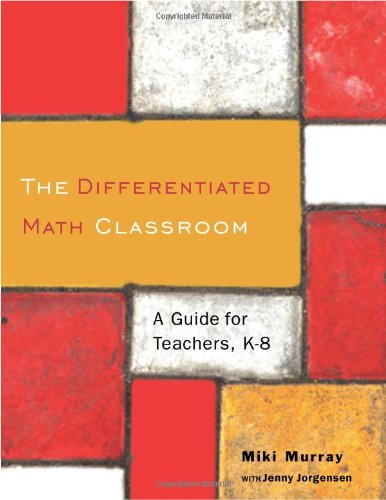
Even though school is  not over yet,  I started my first book for the summer: The Differentiated Math Classroom, A guide for Teachers K-8, by Miki Murray.

The author of the the book wrote: " We believe deeply that all students can learn mathematics when they have access to quality teaching and learning experiences.", and I agree

I read Chapter 1: Guidelines and a Differentiated Unit. This first chapter makes you think and clears up any misconceptions on differentiating lessons. Before you start to create a lesson ask yourself " why is it necessary to differentiate?" Is it to modify to make learning accessible for all students, is it to focus on learning styles,  is to make learning more efficient and interesting, or is it a combination of those ideas. The answer to that question will help guide your lesson in the right direction. There is a great place value lesson example in this chapter as well. It is fabulous. 

My favorite quote from this chapter, "There are many layers to the differentiating process, but we find it helpful to keep good problem-solving tasks at the forefront of the lesson-design routine."

Happy reading. 

Monday, May 13, 2013

I love this idea for the problem of the week, could even have students check other's work and justify why they think that answer is correct.


Thursday, April 25, 2013

The 3 R's and OWL

I attended another great session at NSTA for science notebooks. The purpose of our notebooks are record, reflect, and reach out. If you are wanting to add something to the notebook ask yourself first if fits in with one of the three R's. If not, it still maybe something for science but it may not need to go in the notebook.

One great to record observations is to use and OWL chart. This chart is similar to KWL but instead of what do you know and what do you want to know the children would record what they observed and what they wonder.

Wednesday, April 24, 2013

Tuesday, April 23, 2013

Foldable Addiction

I have a problem, but it's adorable, so I've been told!!! I love foldables. They are a great tool for student engagement and organization. I had the pleasure of attending one of Dinah Zike's mini sessions at NSTA in San Antonio a few weeks ago. She is amazing and inspiring.
I found a Reading/Study Skills and a Math Book with tons of foldable ideas.
There are many more books to choose from on her website: http://www.dinah.com/

Here is a sample for my Biography Display Cube Project with an accordion timeline pocket attachment.


Teacher Toolkit

Need engagement ideas and activities for your classroom?
Teacher Toolkit is a great website, created by Region 13, to find the tools your are looking for. It is very easy to navigate and there are great templates available for all grade levels and content areas. Check it out today.

Monday, April 22, 2013

Processing Standards


What are your students doing in science?
Hopefully, they are investigating, observing and exploring. I have spent a lot of time the last few weeks defining the process standards and what they might look like in the classroom through the year. Thanks to region 13, I was able to organize my notes and share with other teachers in our district.
Kinder   First   Second   Third   Fourth   Fifth

Problem Solving

I worked with some third grade students last week on problem solving strategies and they inspired me to create some task cards. Enjoy.

Thursday, April 4, 2013

Personal Financial Literacy

The new math TEKS are coming soon and we have a new strand to learn and teach; personal financial literacy. There is a conference this summer in San Antonio for educators in June. It would be a great opportunity to learn and share ideas on teaching this new strand. Here is the link if you are interested. 

TCEE Smarter Texas Conference

Wednesday, April 3, 2013

Math and Science Notebooks

I loved our science notebooks last year. The kids did a great job with them. I felt they told our science story for the year. Our math notebooks on the other hand were a different story. They were an unorganized mess and I just couldn't get a grip on what I wanted them to look like. After searching all summer I found this great blog that gives step by step directions and photos.

If you want to have great notebooks for next year, you need to check out this blog:
Even though, I am not in the classroom next year, I am going to set up a math and science notebook for trainings that I attend and/or give. I can't wait to share. 

Welcome


My name is Ginger Bordeau. I have been an educator for 19 years. Many of those 19 years were spent teaching math and science in elementary schools. I did a brief time in middle school teaching math and then returned to elementary. 
This is my first year as an Instructional Coach with HaysCISD. 
My passion is math and science and I want to share great ideas I find with my educator friends. 
Welcome to my blog.